
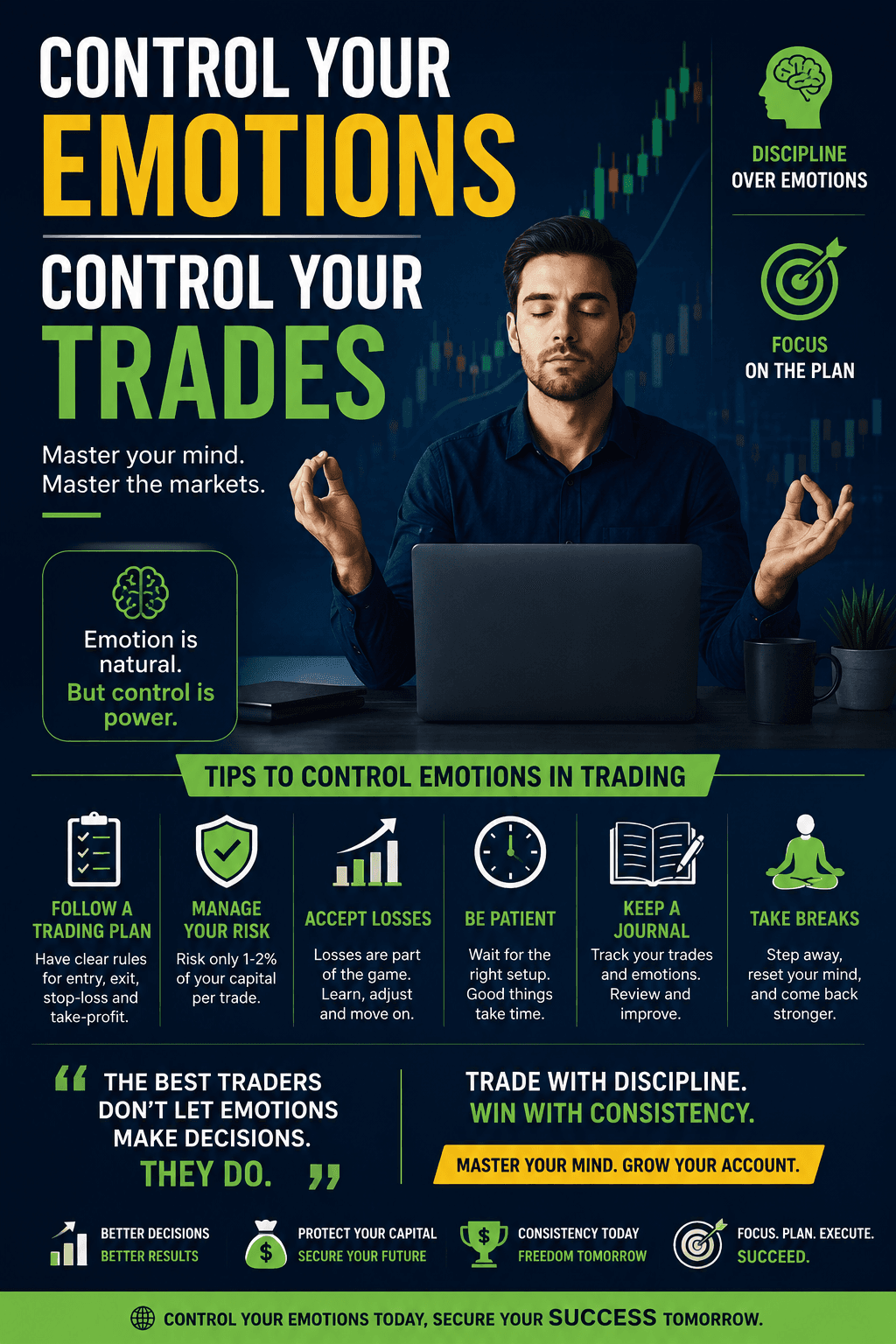
How to control emotions in trading
How to Control Emotions in Trading
Trading is not just about strategies, indicators, or market analysis. One of the biggest reasons traders fail is because they cannot control their emotions. Fear, greed, revenge trading, and overconfidence can destroy even the best trading plan. Successful traders understand that emotional discipline is just as important as technical skills.
In this blog, we will discuss practical ways to control emotions in trading and become a more disciplined trader.
Why Emotions Affect Trading
The financial markets move quickly, and every trade involves money, risk, and uncertainty. Because of this, traders often experience strong emotions such as:
- Fear of losing money
- Greed for bigger profits
- Stress after consecutive losses
- Excitement after winning trades
- Frustration from missed opportunities
When emotions take control, traders usually make impulsive decisions instead of following their strategy.
Common Emotional Mistakes Traders Make
1. Revenge Trading
After taking a loss, many traders immediately enter another trade to recover the money quickly. This often leads to even bigger losses.
2. Overtrading
Some traders take too many trades because they feel they must always be in the market. Overtrading increases risk and reduces focus.
3. Fear of Missing Out (FOMO)
Traders often enter trades late because they are afraid of missing a big move. Most of the time, this results in poor entries.
4. Greed
Holding trades too long without following take-profit targets can turn winning trades into losing ones.
5. Lack of Patience
Many traders cannot wait for proper setups and start taking random trades.
How to Control Emotions in Trading
1. Follow a Trading Plan
A trading plan helps remove emotional decisions. Your plan should include:
- Entry rules
- Stop-loss placement
- Take-profit targets
- Risk management
- Trading schedule
When you follow a plan, you trade with logic instead of emotions.
2. Use Proper Risk Management
Never risk too much on a single trade. Professional traders usually risk only 1% to 2% of their account per trade.
Good risk management reduces stress and helps you stay calm during losses.
3. Accept Losses as Part of Trading
Losses are normal in trading. Even the best traders lose trades regularly. Instead of trying to avoid losses completely, focus on managing them properly.
A single loss does not define your trading career.
4. Avoid Overtrading
More trades do not always mean more profits. Wait for high-quality setups that match your strategy.
Sometimes the best trade is no trade.
5. Keep a Trading Journal
Write down every trade you take, including:
- Why you entered
- Your emotions during the trade
- Profit or loss
- Mistakes made
A trading journal helps you identify emotional patterns and improve discipline.
6. Take Breaks After Losses
If you experience multiple losses in a row, step away from the charts. Trading while frustrated or angry often leads to emotional decisions.
A short break can help you reset your mindset.
7. Focus on Long-Term Consistency
Many traders focus only on daily profits. Professional traders focus on consistency over months and years.
Do not let one winning or losing trade affect your emotions too much.
The Psychology of Successful Traders
Successful traders are not emotionless. They simply learn how to manage emotions better than others. They understand:
- Discipline is more important than excitement
- Patience creates better opportunities
- Risk management protects capital
- Consistency beats quick profits
Trading is a marathon, not a sprint.
Final Thoughts
Controlling emotions in trading is one of the most important skills for long-term success. A strong mindset, proper risk management, and a disciplined trading plan can help traders avoid emotional mistakes.
Remember, the goal is not to win every trade. The goal is to trade consistently, protect your capital, and improve over time.
About the Author
Mohammad Waseem
I’m the Co-Founder and CTO of Onyxbulls, leveraging 5 years of hands-on experience in live and funded forex accounts to deliver expert education, personalized consultation, and professional fund management in global financial markets.